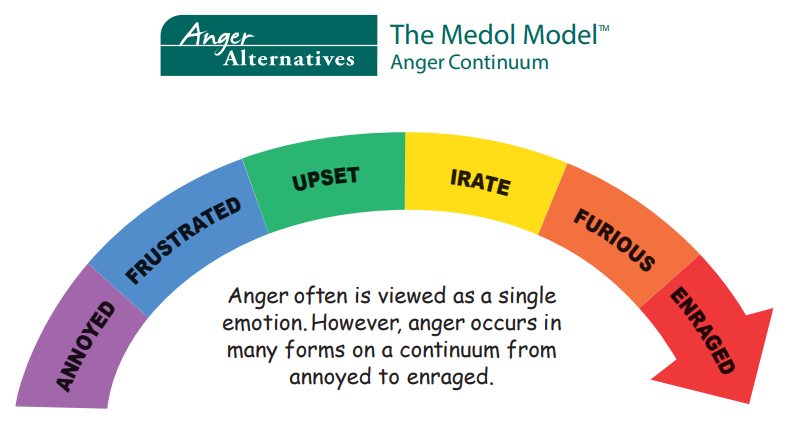
About Anger and Anger Problems

Anger is a feeling that tells me that I am hurt and I don’t want to be hurt.

Anger is about what I don’t want. When I learn not to react to anger and look at it as a mirror, it identifies what I do want.

The "Gift of Anger" is to be able to go after what I want instead of fighting with what I don’t want.

An anger problem is any anger-related behavior (verbal, physical, or emotional) that is hurtful to me or someone else.

Anger knows no gender

Both men and women have anger problems.

Anger is a real feeling that tells you that you are hurt. If you don’t know how to recognize when you are hurt, your energy grows unaware. If you get to a point where you act instead of think, you have mismanaged your anger.

When you have an anger problem, getting stuck in your anger can lead you to blame and punish others for your pain. Once you have reacted to anger, you have allowed your feelings to control you. This could lead you to behaviors you never would have done if you were making rational choices.

You have no right to put your attitude on anyone. You probably know that, and you probably feel pretty bad about what you may have said or done.

  • The problem is not that you are wrong
  • The problem is not that you were angry
  • The problem is that you were out of control

Feeling Safe

People feel safe around those they respect and trust. It is not safe to be around somebody who breaks the rules of respect and takes his or her emotions out on others.

  • Anger that is aggressive, passive, depressive, or manipulative is likely to be destructive and hurtful
  • Anger problems usually keep getting worse until they are addressed, responsibility is taken, and the behavior is changed

Managing Anger

  • Anger is a healthy feeling
  • Anger serves a constructive purpose and has a healthy message
  • Anger can tell you what you don’t want
  • Anger can tell you when, how and in what ways you are hurt
  • Anger can tell you how deep that hurt is
  • Anger can tell you how to heal that hurt

Knowing how to manage anger can help you know how to set limits and determine boundaries in your relationships.

Knowing when you are angry can teach you what you need.

Knowing what you are angry about can teach you what you want

You may have an anger problem if:

  • You were disrespected as a child
  • You show disrespect for others or yourself
  • You act on feelings without thinking
  • You blame others for how you feel
  • You do not know how to tell somebody when you are hurt
  • You use addictive behaviors (alcohol, drugs, sex, work, etc.) to avoid feeling

You are likely coping the best you know how with the skills you have learned.

We all do the best we can with the tools we have learned.

  • That does not make you wrong.
  • It does not make the people who taught you wrong
  • It does mean you are responsible to learn to stop the behavior
  • It does mean you have to learn how to stop reacting if you want to stabilize your life and be a healthy part of the lives of those around you

You are not the problem

How you are behaving is the problem.

You can change.

You can break the anger pattern.

By using RT© and PAF©, Anger Alternatives teaches you tools:

  • To control reactions
  • To separate the anger from the behavior
  • To recognize hurts
  • To recognize needs and wants
  • To speak for yourself
  • To establish limits and boundaries.
  • To recognize other options
  • To make healthy choices
  • To achieve balance in your life
  • To establish and maintain respect-based relationships

It is not reasonable to lose control and hurt somebody you love with words or actions.

Those behaviors hurt others’ emotional well-being. Those behaviors violate others’ trust.

If other people around you are also reactive, everybody’s lives are harmed. If there are children, you are teaching them the same anger behavior.

Anger Alternatives teaches the tools to heal the wounds we carry and stop the wounds we create.